

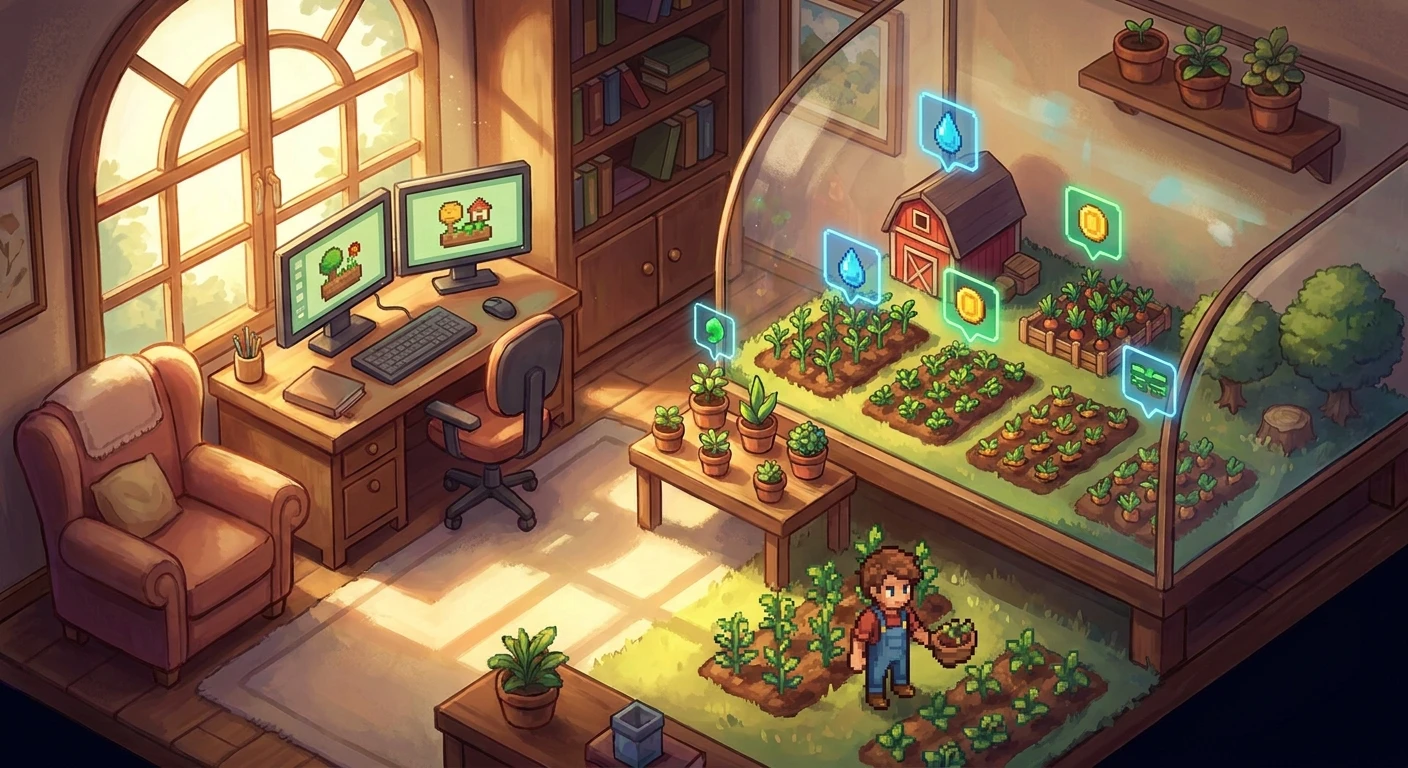
What Actually Makes a life sim Tick?
Whenever I boot up a new life sim, I immediately look for ways to break the economy or build the most absurd house imaginable. There is something intensely gripping about taking a blank slate and turning it into a thriving virtual existence. Honestly, my absolute obsession with this genre skyrocketed a few years ago during the rolling winter blackouts in Kyiv. While the sirens wailed outside and my apartment sat in total darkness, my only escape was a fully charged Steam Deck. I would retreat into my cozy virtual village, planting digital carrots and chatting with pixelated neighbors. It gave me a profound sense of control when the real world felt entirely unpredictable.
You see, the core thesis of any great game in this genre is that it acts as a mirror. It reflects our innate human desire for structure, progression, and creativity, all wrapped up in a stress-free environment. We love seeing numbers go up, we love making a space our own, and we love routines that reward us consistently. When you sit down with your favorite controller or keyboard, you are not just passing time; you are actively engaging in a highly structured psychological loop that feeds your brain steady drops of dopamine. Whether you are managing a booming agricultural empire or just trying to get your character to work on time, the appeal is universal and incredibly powerful.
The Mechanics Behind the Magic
So, why do we keep coming back to these games day after day? The secret sauce lies in the delicate balance of freedom and responsibility. The true value proposition here is that you get all the satisfaction of completing chores and achieving life milestones without any of the real-world exhaustion or financial risk. Take Stardew Valley, for example. It hooks you with the promise of a peaceful farming lifestyle, but keeps you grinding for that next sprinkler upgrade. Then you have The Sims, which leans heavily into architectural design and spontaneous neighborhood drama. Both games offer distinct flavors of escapism, yet they share the exact same underlying architecture of player-driven goal setting.
Let us look at how different titles balance their core focus and overall vibe to keep us glued to the screen.
| Game Title | Primary Focus | Overall Vibe |
|---|---|---|
| The Sims 4 | Architecture & Social Drama | Chaotic Sandbox |
| Animal Crossing | Real-time Collection & Decor | Cozy & Relaxing |
| Stardew Valley | Economy & Relationship Building | Grindy but Rewarding |
To really grasp how these systems manipulate our attention, you have to look at the three foundational pillars every successful title relies on. Without these, the experience simply falls flat:
- Resource Management and Gathering: This is your money, your wood, your energy meter. It forces you to make decisions about how to spend your limited daily time.
- Relationship Progression: NPCs are essentially complex vending machines for lore and unique items. Giving gifts and talking daily builds a social web that makes the town feel alive.
- Environmental Customization: Upgrading your house, changing your outfits, or rearranging your farm gives a permanent visual representation of your progress.
When these three loops intersect flawlessly, you lose track of time entirely. You log in to water some plants and suddenly four hours have passed and you are mapping out a massive spreadsheet for your next harvest.
How We Got Here
The Humble Origins
You cannot really talk about virtual living without paying respect to the absolute pioneers of the industry. Back in 1985, a weird little piece of software called Little Computer People essentially invented the concept. You had this tiny dude living inside your Commodore 64, and you just watched him go about his day, occasionally giving him suggestions. It was incredibly basic, but the foundation was laid. Fast forward to the late 90s, and suddenly everyone had a Tamagotchi attached to their backpack. The idea that a digital entity required your real-world time and attention to survive was a massive shift in how we interacted with technology. It taught a whole generation the basics of digital empathy and schedule management.
Evolution Through the 2000s
Then Will Wright came along and completely blew the roof off the industry. After building massive cities, he zoomed all the way in to focus on individual households. The release of his legendary franchise in the early 2000s proved that playing with a virtual dollhouse wasn’t just a niche hobby; it was a global phenomenon. Around the same time, Nintendo dropped Animal Crossing on the GameCube, introducing the concept of tying gameplay to the real-world clock. If it was snowing outside your window, it was snowing in your game. This era defined the standard rulesets we still play by today. Developers realized that giving players total agency over mundane tasks was somehow more engaging than fighting dragons or saving the universe.
The Modern State of the Genre
Right now, as we push through 2026, the landscape is absolutely wild. We are seeing massive AAA studios trying to compete with brilliant indie developers who are constantly pushing boundaries. The modern titles feature breathtaking photorealistic assets, insanely deep personality algorithms, and vast open worlds that remember every single action you take. But honestly, the pixel-art cozy games are still dominating the charts because they understand that complex graphics cannot replace a deeply satisfying gameplay loop. We have games entirely focused on running taverns, managing futuristic space colonies, and even surviving as a stray cat. The boundaries have expanded, but the core heart of the genre remains exactly the same: giving players a comfortable space to exist.
Under the Hood of Virtual Living
AI Behavior Trees Explained Simply
Have you ever wondered why your virtual neighbor randomly decides to start a fight or bake a cake at 3 AM? It all comes down to AI behavior trees. Think of a behavior tree like a massive flowchart inside the game’s brain. When an NPC is standing idle, the game constantly asks a series of questions: Is the character hungry? Are they tired? Is there a fire nearby? Based on the character’s unique traits and current needs, the tree routes them down a specific path. If their “fun” meter is low and a TV is in the room, the logic points them directly to the couch. It is honestly just math and logic checks happening dozens of times a second, but when layered together, it creates the illusion of genuine free will and quirky personality.
Procedural Generation and State Management
Another massive technical hurdle is state management. When you drop a single sock on the floor of your virtual bedroom, the game has to remember exactly where that sock is, forever, until you move it. Now multiply that by thousands of objects across an entire neighborhood. State management systems ensure that when you leave your house and come back three days later, the world is exactly as you left it, minus the food that probably rotted in your fridge.
Here are a few quick scientific facts about the tech running these simulations:
- A-Star (A*) Pathfinding: The most common algorithm used to help characters navigate around furniture without walking into walls.
- Tick Rates: The simulation updates in “ticks.” Most games calculate logic 20 to 60 times per second to keep time flowing smoothly.
- Memory Footprints: Because every object has a designated state (dirty, clean, broken, functional), these games require massive amounts of RAM compared to linear shooters.
- Floating Point Precision: Managing money and tiny precise object placements relies on complex floating point math to ensure items snap together correctly.
The 7-Day Life Sim Mastery Plan
Day 1: Establishing Your Routine
Look, your first day is always going to be a chaotic mess. You usually start with nothing but the clothes on your back and a tiny, dilapidated plot of land. Your only goal on Day 1 is to establish a basic daily routine. Figure out exactly how long it takes your character to wake up, eat, and travel to the main resource areas. Do not worry about making money yet. Just map out the town, find the major shops, and get a feel for how fast the in-game clock ticks down.
Day 2: Economic Foundation
Now that you know your way around, it is time to hustle. Identify the easiest, most reliable source of early-game income. Usually, this means fishing, foraging for wild berries, or planting the cheapest, fastest-growing crops available. Spend your entire stamina bar or available time gathering these resources. Sell everything you do not immediately need to survive. You are building a war chest to fund your future expansions.
Day 3: Social Networking
By day three, you need to start talking to the locals. Pick two or three key NPCs—usually the ones who sell upgrades or offer vital tools—and start feeding them gifts. Even if it is just a random flower you found on the ground, that tiny boost in relationship points will pay off massively later. Ignoring the social aspect in the early game is a rookie mistake that will lock you out of crucial recipes and story events.
Day 4: Optimizing Your Layout
You have some cash and a few friends. Now, stop running around like a headless chicken and optimize your workspace. Move your storage chests right next to your front door. Consolidate your farming plots or crafting tables into a tight, efficient grid. The less time you spend walking back and forth to put things away, the more time you have to actually play the fun parts of the game.
Day 5: Mid-Game Goals
This is where you set your sights on a massive upgrade. Maybe it is the next house expansion, an automated sprinkler system, or a brand new vehicle. Whatever it is, calculate exactly how much wood, stone, and currency you need. Dedicate this entire day to hyper-focusing on those specific materials. Ignore distractions, ignore side quests, and just grind out the necessary resources for your big leap forward.
Day 6: Automation and Delegation
If you are playing right, Day 6 is when the pressure starts to drop. Use the upgrades you bought yesterday to automate your chores. If you have sprinklers, you no longer need to spend the morning watering. If you have a better oven, cooking takes half the time. Use this newly freed-up schedule to explore the deeper, more dangerous parts of the map, like the mines or the dense forests, where the high-tier loot hides.
Day 7: Creative Expression
You made it to the end of the week. Your economy is stable, your chores are automated, and your character is thriving. Now, you get to do the best part: making things look pretty. Spend your excess cash on wallpaper, fancy rugs, or exotic pets. Rearrange your furniture just because you feel like it. The survival phase is over; you are now firmly in the thriving phase. Enjoy the sandbox you worked so hard to build.
Busting Common Tropes
People who do not play these games tend to have a lot of weird misconceptions about them. Let us clear a few things up quickly.
Myth: They are just digital chores and feel like real work.
Reality: Unlike real work, the tasks here have guaranteed, immediate, and tangible rewards. Washing dishes in real life gives you clean dishes. Chopping wood in a game gives you the exact materials needed to build a castle in ten minutes.
Myth: You cannot actually “lose” these games.
Reality: While there isn’t a traditional game-over screen, you can absolutely ruin a playthrough through terrible financial management or accidentally letting your favorite neighbor move away out of neglect.
Myth: They are strictly for casual gamers.
Reality: The spreadsheet warriors who calculate optimal crop yields down to the fraction of a cent are some of the most hardcore, dedicated players in the entire gaming community.
Myth: The genre hasn’t evolved since the early 2000s.
Reality: Modern entries use highly sophisticated procedural generation and complex emotional AI that were literally impossible on older hardware.
Everything Else You Wanted to Know
What defines this genre exactly?
At its core, it is any game where the primary gameplay loop revolves around maintaining and improving a day-to-day existence. It usually lacks combat as a primary focus, leaning heavily into economy, social interaction, and design.
Are there multiplayer options?
Absolutely. While historically a solo experience, the majority of massive hits today offer cooperative modes where you can share a town or farm with up to four, or even eight, friends simultaneously.
Can I play on mobile?
Yes, the mobile market is flooded with ports of PC classics and original touch-friendly entries. However, keep an eye out for aggressive microtransactions that artificially slow down your progress.
Do I need a powerful PC?
Generally, no. The indie scene leans heavily into low-poly or pixel-art aesthetics, meaning you can run many of the best titles on a decade-old laptop without any major framerate drops.
What is the most realistic option available?
If you want hyper-realism, you are mostly looking at heavy PC mods for existing franchise giants. The modding community has created incredibly complex systems for taxes, realistic aging, and complex careers.
How long does a typical playthrough last?
There is rarely a definitive end. You can technically hit the “credits” in some games after 40 to 60 hours, but most players easily log 300 to 500 hours perfecting their custom layouts.
Are they safe for kids?
They are generally fantastic for younger audiences. They teach resource management, basic math, and reading skills in a completely non-violent, stress-free sandbox environment.
Alright, you have all the theory, the history, and a rock-solid seven-day plan to get started. There is absolutely no reason to hold off any longer. Grab your platform of choice, pick a game that matches your vibe, and start building your perfect digital life today. The virtual neighborhood is waiting for you!
Leave a Reply