

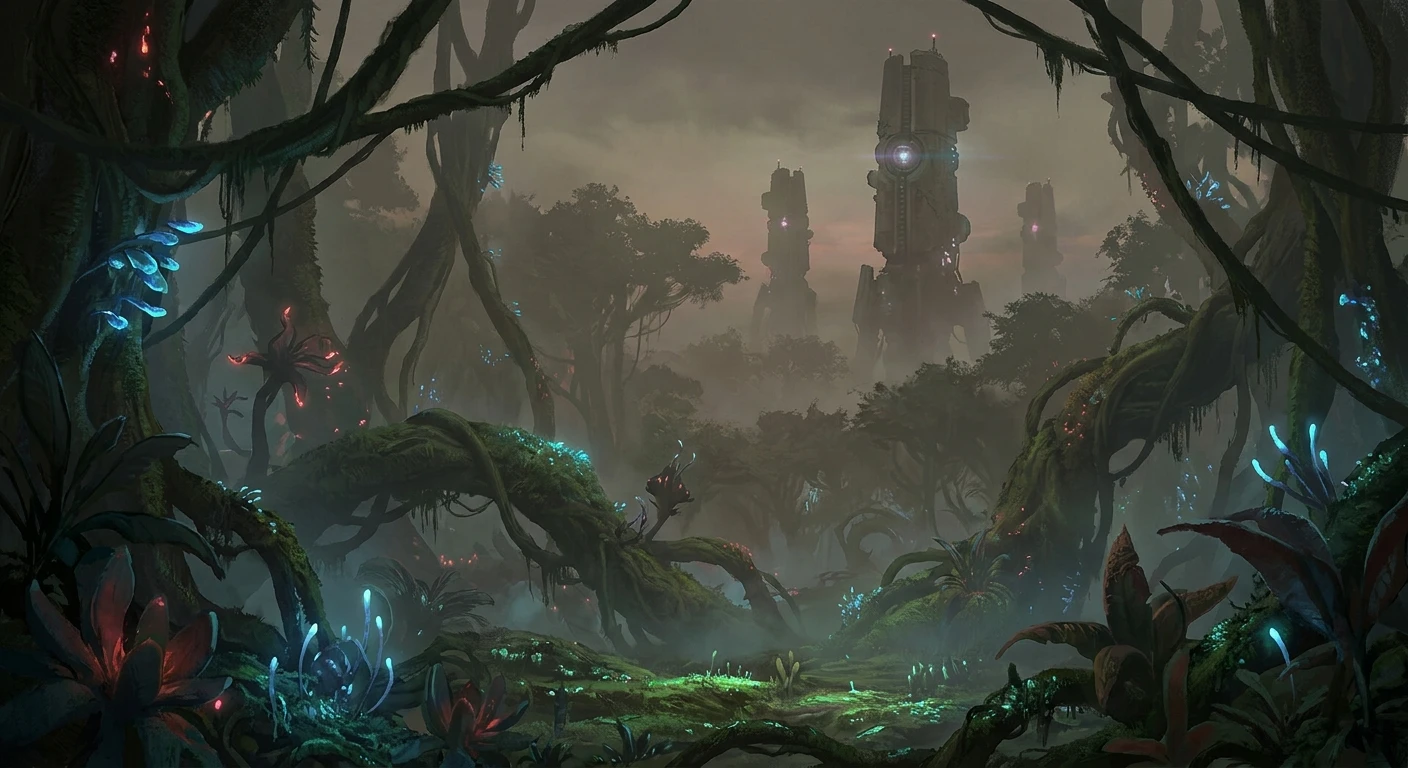
Surviving the Digital Jungle of Malevelon Creek
Let us talk directly about Malevelon Creek, the infamous jungle planet that fundamentally redefined co-op gaming lore. If you actively play the interstellar shooter phenomenon that took the world by storm, you already know this specific name sends immediate shivers down a veteran player’s spine. It serves as a dense, intensely atmospheric hellscape populated by relentless mechanical adversaries and suffocating, thick foliage that obscures everything. But why does this specific virtual location hold such a massive place in gaming culture, even now as we navigate the interactive entertainment landscape of 2026? The truth lies strictly in its punishing environmental design and the sheer volume of organic community storytelling it generated overnight.
You often hear seasoned players refer to this battleground as an absolute meat grinder for a very specific reason. The dense upper canopy blocks out crucial tactical orbital strikes, and glowing red mechanical optics pierce directly through the heavy, stagnant mist, creating an atmosphere of constant, unrelenting tension. My goal right now is to break down exactly what makes this digital ecosystem function, from its core environmental hazards to the exact loadouts required to survive a standard deployment. We are looking directly at the calculated environmental engineering, the strategic layout of the map grids, and the collective digital trauma of millions of players who tried to hold the line. Prepare to thoroughly understand the underlying mechanics, the fascinating community history, and the optimal survival strategies required for this legendary digital combat zone.
Read also: Power Rod Room Arc Raiders Survival Guide; When Does the New Overwatch Season Start? Find Out Now.
Whether you are a raw recruit dropping into the mud for the first time or a hardened veteran returning to the thick jungle canopy, mastering this environment requires absolute patience and cold precision. We will analyze the terrain structure, the specific enemy patrol spawn rates, and the most reliable tactical approaches to secure victory.
The sheer, unfiltered difficulty of the terrain is exactly what separates rookies from experts on this map. The primary challenge stems directly from the chaotic interplay between poor visual clarity and heavy enemy armor plating. The value of genuinely mastering this specific planet is twofold: first, it aggressively forces you to improve your raw situational awareness; second, it practically guarantees you will understand complex stealth mechanics. Take, for example, the heavy armored patrols roaming the sectors. Instead of engaging them head-on in the thick brush where visibility is zero, highly skilled players use the dense foliage to slip by completely undetected. Another prime example of high-level play involves intentionally utilizing the planet’s natural, rolling ion storms to mask your aggressive approach toward heavily guarded manufacturing outposts.
Here is a detailed breakdown of the primary environmental hazards you actively face on the surface:
| Environmental Hazard | Tactical Effect on Gameplay | Optimal Player Countermeasure |
|---|---|---|
| Dense Jungle Canopy | Physically blocks vertical orbital targeting lasers | Use precise eagle airstrikes or low-angle horizontal barrages |
| Rolling Ion Storms | Temporarily disables the minimap and stratagem uplinks | Rely heavily on compass navigation and pure stealth tactics |
| Thick Volumetric Fog | Severely reduces visual range to less than thirty meters | Equip specialized thermal scopes and ping targets constantly |
To genuinely succeed on the ground level, you must radically adapt your basic infantry tactics. The standard run-and-gun approach universally results in immediate mission failure. Instead, you need to internalize a few strict operational rules.
- Always maintain strict cover discipline. The glowing red optics of your mechanical enemies can spot you through thin bushes, so actively put solid rock formations or thick tree trunks between you and the roaming patrols.
- Coordinate your squad loadouts meticulously before the drop. You absolutely need dedicated anti-armor specialists to handle the heavy troop dropships, alongside crowd-control players to manage the smaller infantry units pressing the flanks.
- Prioritize constant movement over static entrenchment. Staying in one place for too long allows the enemy AI to box you in with heavy suppressing fire, so hit your primary objectives quickly and aggressively rotate to the next grid sector.
Origins of the Planet’s Design
When the original developers mapped out the galactic war interface, they explicitly needed a biome that felt deeply oppressive and distinctly alien, yet thoroughly grounded in familiar cinematic military tropes. The creative origins of this specific planet lie heavily in classic science fiction jungle warfare films. The environmental designers meticulously built a dense, swamp-like jungle featuring towering alien trees and a permanently overcast sky, ensuring that dynamic lighting played a massive role in setting the dread-inducing mood. The deep dark blues, muted greens, and heavy purples of the surrounding environment directly contrast with the harsh, glowing red eyes of the robotic faction. This highly intentional color grading makes every single firefight feel incredibly intense, chaotic, and visually striking.
Evolution of the Community Campaign
The global player base quickly gravitated toward this specific planet, spontaneously sparking a massive, entirely unscripted community campaign. Players were failing standard missions at unprecedented, record-breaking rates, yet they stubbornly kept dropping back into the combat zone. High-quality memes flooded social media platforms, highly detailed propaganda posters were hand-drawn by dedicated fans, and a powerful collective narrative organically emerged. The massive community treated the ongoing planetary battle not just as a standard game level, but as a genuinely shared cultural event. Co-op squads would willingly spend countless hours trying to push the global liberation meter up by a single fraction of a percent, only to bitterly watch it fall right back down by the next morning due to the aggressive enemy reinforcement algorithms.
The Modern State of the Sector
As we navigate the competitive gaming landscape of 2026, the powerful legacy of that initial historical push remains completely intact. The studio developers explicitly recognized the community’s fierce attachment and officially canonized the struggle into the official lore, awarding special commemorative capes to players who actively participated in the brutal liberation campaign. Today, the planet occasionally rotates back into active conflict zones on the galactic map, serving as a highly nostalgic yet incredibly brutal testing ground for new stratagems, heavy weapons, and mechanized suits. It stands proudly as a prime, textbook example of how emergent gameplay mechanics and raw community passion can elevate a simple digital map into a legendary piece of interactive history.
Topographical and Atmospheric Engine Mechanics
From a strictly technical perspective, rendering a massive jungle environment packed with heavy volumetric fog naturally requires serious graphical processing power. The proprietary game engine utilizes advanced, highly optimized particle systems to accurately simulate the thick mist that constantly rolls through the deep valleys and riverbeds. The dynamic lighting engine is particularly impressive in this biome, calculating complex shadows cast by the dense canopy to naturally obscure long lines of sight. Every single thick tree trunk and heavy fern leaf features its own highly accurate collision mesh, meaning they physically block incoming and outgoing projectiles. This isn’t just a cheap visual trick; it is a core mechanical feature that fundamentally alters how you handle gunfights.
Algorithmic Enemy Spawning Systems
The underlying AI director governing the enemy reinforcements operates on a specific algorithmic loop highly tailored to this exact biome. The server-side system constantly calculates your squad’s overall noise output and visual footprint. When an enemy patrol spots you, the bright red flare they shoot into the sky immediately triggers a specialized, location-based drop-ship spawn routine. The algorithms explicitly prioritize aggressive flanking maneuvers, actively utilizing the heavy cover of the dense jungle to completely surround players rather than marching forward in a predictable straight line.
Let us closely examine the underlying technical facts that govern this digital world:
- The volumetric fog density automatically scales dynamically based on the specific in-game time of day, peaking severely during the early planetary dawn.
- Foliage collision is entirely non-uniform, explicitly meaning light energy weapons will dissipate harmlessly against broad leaves while heavy ballistic rounds can easily punch through thin trees.
- The AI patrol paths are heavily procedurally generated but inherently favor narrow, highly restrictive choke points located between large rock formations and deep rivers.
- Complex audio occlusion is heavily modified by the terrain geometry; the thick trees significantly muffle the sound of approaching mechanical footsteps until they are dangerously close to your position.
Understanding these strict technical boundaries directly allows players to successfully manipulate the AI director, drawing them into prepared kill zones rather than fighting purely on their terms.
Phase 1: Tactical Loadout Selection
Before leaving the safety of the destroyer ship, you must equip light or medium armor featuring the Scout passive ability. The distinct ability to ping the tactical map and instantly identify enemy radar signatures is entirely non-negotiable in the dense fog. Bring the heavy Autocannon or a dedicated anti-materiel rifle for long-range threat neutralization.
Phase 2: Choosing the Optimal Drop Zone
Never, under any circumstances, drop directly onto a primary objective marker. Carefully select a highly clear patch of terrain near the extreme edge of the map to actively avoid immediate enemy detection. Dropping into a hot zone completely surrounded by thick foliage usually results in an immediate, chaotic squad wipe.
Phase 3: Silent Perimeter Scouting
Once boots hit the ground, absolutely do not sprint right away. Crouch-walk silently through the first sector. Actively use your wrist map to identify the glowing red dots representing enemy patrols and consciously chart a safe path completely around them.
Phase 4: Engaging Primary Targets
When you must ultimately attack a heavily fortified base, carefully position your squad on elevated high ground. Coordinate your powerful airstrikes over voice comms to hit the targets simultaneously, wiping out the robotic fabricators right before the enemy infantry can launch a distress flare.
Phase 5: Managing the Reinforcement Loop
If an enemy flare goes up, you have roughly ten seconds before heavy dropships arrive on the scene. Immediately drop orbital gas strikes or static EMS fields directly under the incoming ships to stun, damage, and disorient the robots the exact second they hit the dirt.
Phase 6: Tactical Retreat Mechanics
Do not attempt to fight endless, repetitive waves of armor. If a primary objective is successfully complete, immediately throw thick smoke grenades at your feet and break the direct line of sight. The jungle is your best friend here; use the shadows to disappear entirely.
Phase 7: The Extraction Defense
Holding the final extraction beacon is routinely the hardest part of the mission. Place your automated sentry turrets on highly elevated rocks, far away from the immediate landing pad, to create devastating crossfire zones. Stay prone, communicate clearly, and strictly conserve your medical stims until the ship lands.
There are countless wild rumors and tall tales surrounding this specific battleground on the forums. Let us clear up the widespread misinformation right now.
Myth: The towering jungle trees are completely indestructible and permanently block all heavy orbital strikes.
Reality: While massive central trunks actively block 500kg bombs, the smaller surrounding trees can be easily destroyed by heavy artillery, and massive orbital lasers will simply burn right through the canopy to reach the ground.
Myth: True stealth gameplay is literally impossible because the AI director strictly knows your exact location at all times.
Reality: The enemy AI heavily relies on a highly strict sight and sound perception system. If you fully break line of sight and immediately go prone, they will only aggressively search your very last known location, completely ignoring your current hiding spot.
Myth: Heavy energy shield backpacks are the absolute only way to survive the relentless laser fire.
Reality: High mobility is actually far more valuable here. The jump pack equipment allows you to completely bypass lethal choke points and scale high cliffs, keeping you completely out of the direct firing line in ways a bulky shield simply cannot match.
Myth: Atmospheric ion storms happen at totally random, completely unpredictable intervals.
Reality: There are actually highly subtle visual atmospheric changes and specific audio cues right before a major ion storm hits, effectively giving highly observant players a brief, crucial window to call in their final requested stratagems.
What is the absolute best primary weapon for this planet?
The energy-based Sickle or the explosive Scorcher are universally considered excellent choices for efficiently managing the medium-armored enemies constantly found patrolling the jungle.
Does the specific time of day actively affect visibility?
Yes, nighttime operations severely limit your overall vision unless you constantly utilize tactical weapon flashlights, though doing so easily gives away your exact position.
Can you successfully outrun the heavy armored Devastators?
Yes, provided you rapidly weave directly through the thick trees to constantly break their mechanical targeting lock.
Are heavy mechanized vehicles effective in the thick jungle?
Walking mechs massively struggle with basic mobility here due to the terrain geometry, making highly agile infantry-focused loadouts far superior.
Do standard smoke grenades actually work against the robotic enemies?
Absolutely. Thick smoke forcefully severs their digital line of sight instantly, safely allowing your entire squad to reposition without taking heavy fire.
Why is the map so incredibly dark even during the day?
The thick atmospheric haze and dense upper canopy naturally block most of the ambient sunlight from ever reaching the muddy surface.
Is it genuinely possible to solo high-level missions here?
Yes, but it strictly requires a pure stealth approach, utilizing light scout armor to maintain exceptionally high stamina regeneration.
Surviving the infamous digital jungle of Malevelon Creek strictly requires immense patience, remarkably sharp situational awareness, and airtight squad communication at all times. Equip your very best tactical gear, completely trust your compass navigation, and never stay in one single place for too long. Dive right back into the frantic fray, trust your teammates, and conquer the ultimate gaming challenge today!
Leave a Reply