

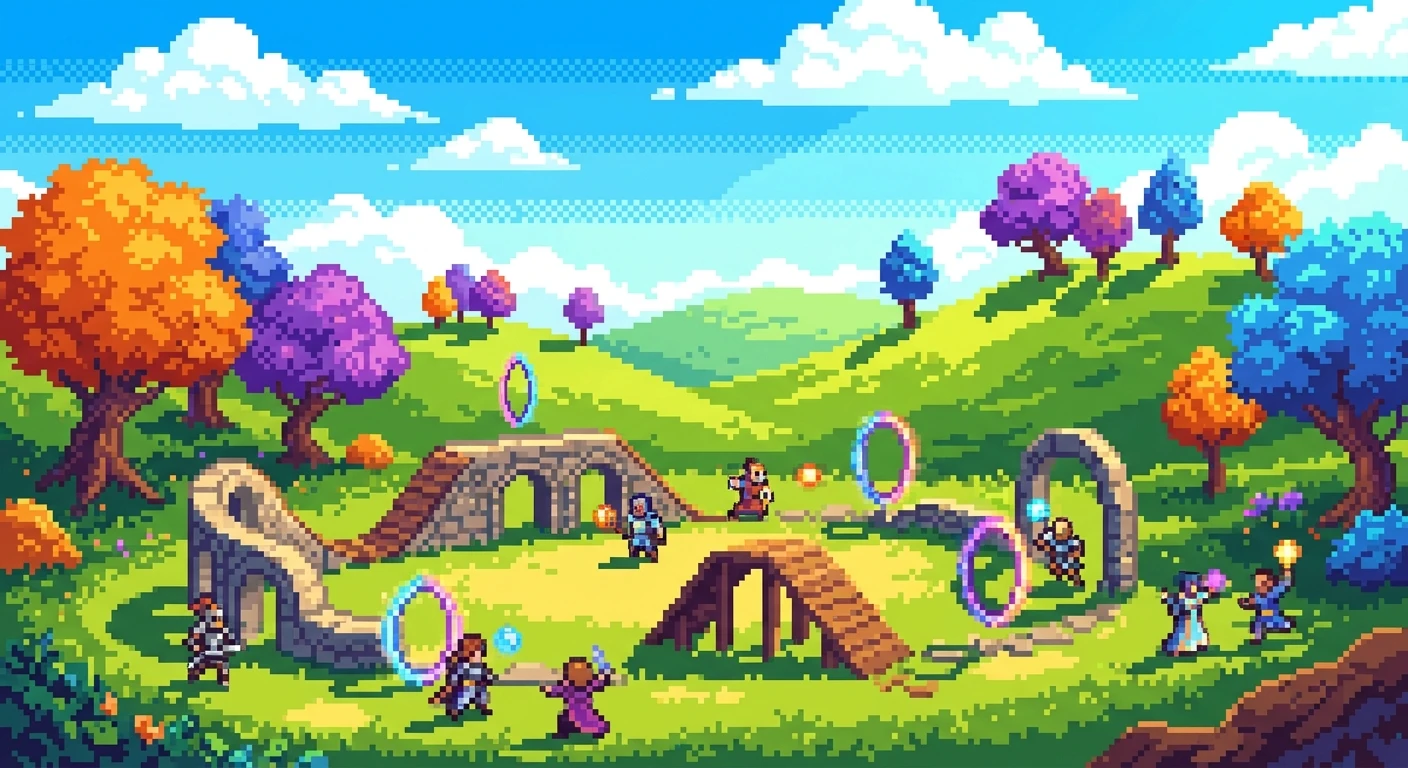
Golf Story: The Ultimate Sports RPG Phenomenon
The indie gaming landscape shifted permanently when Golf Story launched, proving that classic sports mechanics and rich role-playing narratives could blend flawlessly into a single, unforgettable experience. If you are stepping onto the digital green for the first time, you are about to discover a game that redefines what a sports title can achieve. Golf Story takes the fundamental mechanics of a precision-based arcade sports game and wraps them entirely within a deep, character-driven adventure filled with side quests, equipment upgrades, and sprawling pixel-art environments. You do not just hit a ball; you solve environmental puzzles, confront rival characters, and level up your abilities in a meticulously crafted world. This unique hybrid approach captured the attention of both hardcore sports fans and traditional RPG enthusiasts, creating a genre-defying bridge between two seemingly disconnected styles of play. The game replaces traditional combat encounters with high-stakes putting challenges, driving contests, and precision chipping mechanics. Every interaction, from fetching an item for an NPC to exploring a hidden dungeon-like area, is resolved through the physics of your clubs. By integrating the core loop of character progression with the skill-based execution of a three-click swing meter, the developers crafted a gameplay loop that rewards both strategic planning and immediate reflex execution. The result is an incredibly dynamic ecosystem where every swing of the club feels narrative-driven, pushing the protagonist closer to becoming a legendary champion while offering players a deeply satisfying sense of mechanical mastery.
Core Gameplay Mechanics: The Perfect Swing
Understanding the fundamental systems operating beneath the surface is crucial for any player looking to dominate the varied courses presented throughout the campaign. The core value proposition of the game lies in its seamless integration of overworld exploration and structured tournament play. You can drop a ball anywhere in the environment and take a swing, turning the entire map into an interactive sandbox. This freedom encourages players to experiment with different clubs, trajectories, and spin techniques outside of formal matches, turning casual exploration into vital practice sessions. As you progress, the difficulty scaling introduces environmental hazards like deep snow, thick mud, and aggressive wildlife that actively interfere with your ball placement. To counter these escalating threats, players must continuously balance their character’s stats, choosing between raw driving power and nuanced shot purity. This dual-layered progression system ensures that brute force alone is never enough to secure victory; you must adapt your strategy to the specific biome and weather conditions of each new area.
Read also: Fable 2025: The Ultimate Xbox RPG Revival; The Best 2022 Video Games to Play Now.
| Gameplay Element | Technical Execution | Player Benefit |
|---|---|---|
| Dynamic Environments | Interactive collision models across varied biomes and weather conditions | Constant engagement and diverse puzzle-solving opportunities |
| Stat Customization | Granular allocation of experience points to specific physical traits | Personalized playstyles matching individual skill levels and strategies |
| Integrated Side Quests | Narrative-driven minigames entirely outside core tournament matches | Meaningful world-building, comic relief, and necessary pacing breaks |
To fully grasp the depth of this system, you need to understand the three distinct pillars that uphold the entire experience:
- Precision Mechanics: Mastering the traditional three-click meter requires absolute focus, as the timing windows shrink progressively as you tackle harder courses and face stronger crosswinds.
- Environmental Puzzle Solving: Using your wedges to trigger switches, knock items out of trees, or skip balls across water hazards transforms a standard sports mechanic into an adventure game tool.
- Narrative Progression: Following the protagonist’s journey from an underestimated amateur to a seasoned professional gives every single tournament stroke emotional weight and meaningful stakes.
History and Origins of the Sports RPG
Origins of the Genre
The concept of fusing athletic competition with role-playing progression did not materialize out of thin air. The lineage of this specific design philosophy traces back to the late 1990s and early 2000s, most notably with handheld titles developed by Camelot Software Planning. Games like Mario Golf on the Game Boy Color pioneered the idea that players could walk around a clubhouse, talk to rivals, and level up stats just like in a traditional fantasy adventure. However, for nearly a decade, this specific subgenre lay dormant. Major publishers shifted their focus toward hyper-realistic simulations, abandoning the charming, story-driven pixel art aesthetics that defined the early days of portable gaming. This massive gap in the market created a distinct hunger among players who craved the addictive loop of grinding for experience points without the stress of managing a massive fantasy inventory or dealing with random combat encounters.
Evolution of the Design
Recognizing this untapped potential, independent developer Sidebar Games set out to revive the dormant formula. The evolution of the game’s design focused heavily on expanding the definition of what a sports game could be. Instead of limiting the action to official tees and greens, the developers made the revolutionary decision to allow the player to tee up from anywhere on the map. This completely altered the design philosophy, transforming the standard top-down perspective into a sprawling puzzle box. Development required a meticulous balancing act: ensuring the physics engine felt rewarding and authentic while keeping the narrative lighthearted and engaging. The team spent countless hours refining the sprite animations, ensuring that every swing, from a gentle putt to a massive drive, carried the necessary visual weight and kinetic feedback to satisfy the player.
The Modern State of Pixel-Art Sports
Today, the landscape of indie sports titles owes a massive debt to the groundwork laid by this release. It proved that independent studios could successfully challenge the established norms of major sporting franchises by leaning heavily into charm, tight mechanics, and genre-blending innovation. The success of this title paved the way for a resurgence in arcade-style sports games, showing publishers that there is a highly lucrative and passionate audience for games that prioritize fun and narrative over licensed rosters and photorealistic graphics. It stands as a testament to the enduring appeal of 16-bit era aesthetics when paired with modern, responsive gameplay architecture.
Scientific and Technical Deep Dive
16-Bit Physics Engine Architecture
Beneath the charming pixel-art exterior lies a surprisingly robust and highly deterministic physics engine. When you initiate a swing, the game calculates a complex set of variables instantly. The engine factors in the club’s specific loft angle, the power percentage dictated by your button presses, the exact point of impact on the ball for spin, and the current wind vector. Unlike older games that relied on simple random number generation to determine the outcome of a slightly missed swing, this engine uses strict mathematical trajectories. This means that if you input the exact same parameters under the exact same environmental conditions, the ball will land in the exact same pixel every single time. This high level of predictability is crucial for a game that demands precision, allowing players to genuinely learn from their mistakes rather than feeling cheated by arbitrary game logic. Furthermore, the collision detection handles various terrain types with distinct friction coefficients, meaning a ball will roll naturally on a manicured green but stop dead when hitting the rough or a sand trap.
Stat Tracking and Character Progression
The progression system is fundamentally driven by a tight mathematical curve balancing Power, Purity, Strike, Ability, and Spin. As you sink experience points into Power to increase your maximum drive distance, the game automatically applies a penalty to your Purity stat, widening the variance of your shot if you miss the perfect hit zone. This creates a brilliant technical balancing act where players cannot simply become overpowered behemoths without also mastering the increasingly demanding timing requirements.
- Trajectory Plotting: Real-time visual feedback updates dynamically based on wind speed and elevation changes, requiring players to understand basic parabolic physics.
- Terrain Friction Coefficients: Each tile type in the game possesses unique drag values, forcing players to calculate rollout distances precisely when approaching the pin.
- Equipment Modifiers: Purchasing new club sets fundamentally alters the baseline stats, providing percentage-based boosts to spin control or penalty reductions in heavy rough.
- Wind Vector Calculations: Crosswinds do not just push the ball laterally; they affect the overall carry distance, requiring complex mental adjustments before every drive.
Actionable 7-Step Mastery Plan
Step 1: Mastering the 3-Click Swing
Your journey begins with absolute dedication to the core mechanical loop. The three-click system requires you to start the meter, set your power, and finally determine your accuracy. Spend your first few hours focusing entirely on hitting the exact center of the accuracy bar. Do not worry about maximizing distance immediately; a perfectly straight, shorter shot is infinitely more valuable than a massive drive that hooks directly into a water hazard.
Step 2: Dominating Wellworn Grove
The opening area serves as your comprehensive tutorial. Take the time to speak to every single NPC scattered around the clubhouse and the practice greens. Many of them offer minor fetch quests or specific chipping challenges that reward you with early experience points. Completing these optional tasks will give you a crucial stat advantage before you even enter your first official nine-hole tournament.
Step 3: Balancing Power and Purity
As you begin leveling up, you will face the temptation to dump all your points into the Power stat. Resist this urge. A high Power stat with a low Purity stat shrinks your accuracy window to a razor-thin margin. Maintain a balanced build, upgrading your Strike and Ability stats to ensure you can actually control the massive drives you are producing. Consistency is the key to winning.
Step 4: Conquering Lurker Valley
When you transition to the second major biome, the game introduces significant environmental hazards, specifically water traps and unpredictable sand pits. Here, you must master the art of applying backspin and topspin. Use the directional pad during your swing setup to alter the ball’s impact point. Backspin will stop the ball dead upon landing, allowing you to aggressively attack pins located near dangerous hazards.
Step 5: Solving Disc Golf Puzzles
Midway through the campaign, the game introduces a completely different mechanic: disc golf. Do not treat this as a mere distraction. The physics of the discs behave entirely differently than the standard balls, floating and curving dramatically based on their aerodynamic properties. Mastering this system is mandatory for completing specific narrative bottlenecks, so practice altering your release angles to navigate through tight forest corridors.
Step 6: Taming the Tundra in Coldwind Wastes
The winter biome drastically alters the friction coefficients of the ground. Ice patches will cause your ball to slide uncontrollably, while deep snow will instantly kill any momentum. In this region, you must rely heavily on your wedge clubs. Focus on aerial carry distance rather than relying on the ball to roll out toward the hole. Precision targeting of small patches of clear grass becomes your primary strategy.
Step 7: Winning the Final Championship
The culminating tournament tests every single skill you have acquired. You will face heavy crosswinds, massive elevation changes, and incredibly complex green layouts. Take your time reading the slope of the greens before putting. Use the grid overlay to analyze the breaks, and remember that uphill putts require significantly more power than downhill sliders. Keep your nerves steady, trust the mechanics you have mastered, and secure the trophy.
Myths and Reality
Myth: You need to understand real-world sports rules to enjoy the game.
Reality: The game functions primarily as an RPG. While basic terminology is used, the mechanics are entirely self-contained, and the game teaches you everything required through interactive, incredibly forgiving tutorials.
Myth: The RPG elements are superficial and do not affect gameplay.
Reality: Your stat distribution fundamentally alters how the game plays. A high-spin build allows for trick shots around obstacles, while a pure power build demands absolute perfection on the timing meter. Your choices matter immensely.
Myth: The game lacks replay value once the story concludes.
Reality: Post-game content includes unlocking hidden courses, maximizing all equipment, and engaging in local multiplayer mode where you can test your customized character against friends in highly competitive matches.
Myth: It is just a straightforward simulator with pixel graphics.
Reality: You will spend time solving murder mysteries, fighting off alligators, feeding ancient turtles, and using your clubs to dig up buried treasure. It is a full adventure game.
Frequently Asked Questions
What is the maximum level you can reach?
Players can continue to level up and refine their stats extensively, though the game is easily beatable around level 30 to 35 depending on your mechanical skill and side quest completion rate.
How long does the main campaign take to complete?
A standard playthrough focusing primarily on the core narrative will take roughly 15 hours. Completionists looking to finish every side quest and unlock all gear will easily push past 20 hours.
Is there a multiplayer mode available?
Yes, the game features a robust local multiplayer mode. You can select different courses, adjust the weather parameters, and compete against friends using the mechanics you mastered in the campaign.
Do different clubs really matter?
Absolutely. Purchasing new club sets alters your base stats and provides specific situational bonuses, such as cutting through thick rough easier or adding massive amounts of backspin to your wedge shots.
Can I respec my character stats?
The progression system is largely permanent regarding how you alter the physical stat sliders, forcing players to commit to their chosen build path and adapt their playstyle accordingly.
Are the side quests mandatory?
While many are optional, skipping them will leave you severely under-leveled for the late-game tournaments. They also provide essential money needed to purchase upgraded equipment from the pro shops.
Does weather affect the ball physics?
Significantly. High winds will push your ball off course, rain limits your maximum rollout distance, and frozen ground causes unpredictable sliding. You must constantly adjust your math.
If you are ready to experience one of the most charming, mechanically tight, and genuinely hilarious games available, it is time to grab your virtual clubs. Dive into the world of Golf Story today and discover why this indie masterpiece continues to capture the hearts of players worldwide. Step up to the tee and start your adventure!
Leave a Reply