
Navigating the Legacy of .hack Zero
If you are piecing together the massive multimedia puzzle of “The World,” exploring .hack Zero provides the exact missing link you need between the screen and the controller. Getting a complete grasp of this expansive cyberpunk universe requires looking beyond the main games and the core anime series. The entire concept of an interconnected transmedia franchise was pioneered here, long before it became a standard industry practice. When you look at the timeline bridging the events of the anime .hack//SIGN and the first PlayStation 2 game, .hack//Infection, a distinct narrative gap exists. That gap is precisely where this specific light novel steps in, focusing heavily on character motivations, lingering digital mysteries, and the sheer unpredictability of a malfunctioning virtual reality MMORPG.
You do not just get a basic recap of past events. Instead, you get a direct, ground-level view of how ordinary players reacted when their favorite digital escape began to fracture. The protagonist, a Heavy Axeman named Carl, serves as the perfect lens for this perspective. She is driven by personal motives, searching the fragmented servers for a notoriously chaotic Twin Blade named Sora. Her journey highlights the raw panic, the spreading rumors, and the terrifying reality of players falling into inexplicable comas. Understanding this storyline equips you with critical context, turning confusing references in the games into brilliant, cohesive storytelling moments.
Read also: Golf Story Guide: Master The Ultimate Sports RPG; The Best 2022 Video Games to Play Now.
The Core Value of the Missing Bridge
To fully appreciate the narrative architecture built by CC Corp—the fictional developers of “The World”—you have to understand what happens when a system operates without its core parameters. The storyline heavily features the fallout of the Morganna System operating outside its original boundaries. Carl’s journey is not just a casual quest; it represents the desperate attempt of the community to make sense of anomalies that the game masters actively ignore. Because the developers refuse to acknowledge the digital decay, it falls entirely on dedicated players to map out the corrupted zones and track down missing users.
This text delivers a profound look at the psychological toll of virtual reality integration. By stepping into Carl’s boots, the reader sees how deep the addiction to the simulation goes. Two primary examples highlight this value proposition. First, the detailed description of root towns directly mirrors the in-game maps, providing a comforting, familiar geometry before thrusting the reader into chaotic, glitch-ridden server instances. Second, the intimate internal monologues of the characters offer emotional depth that standard NPC dialogue boxes in a 2002 video game simply could not achieve.
| Character Name | In-Game Class | Narrative Function in the Story |
|---|---|---|
| Carl | Heavy Axeman | The primary protagonist, driven by a stubborn need to locate a missing friend amidst server instability. |
| Sora | Twin Blade | The elusive, mischievous player who holds vital information regarding the Morganna System and Skeith. |
| Tsukasa | Wavemaster | The catalyst for the prior server crisis, acting as the narrative anchor connecting past and present events. |
Following this narrative provides three fundamental insights into the broader universe:
- Server-Level Consequences: You witness exactly how regular players perceive the sudden quarantining of specific servers, which sets up the restrictive atmosphere of the initial games.
- The Evolution of A.I.: The text outlines the early, erratic behaviors of wandering artificial intelligence, framing them as urban legends before they become main antagonists.
- Character Continuity: It firmly establishes why certain high-level players, like Balmung of the Azure Sky, act with such extreme caution and distrust toward the system administrators later on.
Origins of the Light Novel
The genesis of this project traces back to the ambitious “Project .hack,” spearheaded by Bandai and CyberConnect2. The creators explicitly designed a universe that could not be fully consumed through a single medium. To grasp the entirety of the timeline, a fan had to watch the anime, read the serialized publications, and play the four-part video game series. Hitomi Fuyumura authored this specific text, aiming to flesh out the immediate aftermath of the anime. It was originally published to keep audience momentum high while the developers finished polishing the mechanics for the PlayStation 2 titles. The conceptual art, provided by Yoshiyuki Sadamoto, perfectly maintained the distinct, slightly melancholic aesthetic that defined the entire franchise.
Evolution Across Multimedia
Over the years, the way fans consumed this lore shifted drastically. Initially, physical magazines and standalone paperback volumes were the only way to access these bridging stories. As the internet matured, the fragmentation of the lore became both a selling point and a hurdle. The text eventually became a heavily referenced artifact within community forums. The transition from physical media to digital preservation meant that dedicated fans had to rely on fan-driven translation projects and comprehensive wikis to stitch the events together, especially since official localized reprints were scarce. The story of Carl and Sora evolved from a promotional tie-in to a legendary piece of foundational lore.
Modern State of the Franchise
Today, finding an original, pristine copy of the localized volume requires serious dedication. It stands as a prized collector’s item. However, the legacy of the story persists strongly within the fan community. Modders, archivists, and lore historians constantly reference its events when analyzing the intricate timeline of “The World R:1” (the first iteration of the fictional MMORPG). While Bandai Namco occasionally re-releases or remasters the later games, like the G.U. series, the foundational texts remain firmly in the domain of retro preservation, living on through detailed retrospectives and dedicated fan databases.
The Architecture of ALTIMIT OS
Understanding the Ultimate Operating System
To truly grasp the stakes of the narrative, you have to understand the fictional technology powering it. In the lore, an apocalyptic computer virus known as “Pluto’s Kiss” devastated the global internet infrastructure. Only one operating system remained immune: ALTIMIT OS. Consequently, every computer, server, and network globally adopted it. “The World” is not just a game; it is the primary application running on the only stable network left on Earth. This monopoly means that when the game servers begin to glitch and cause real-world medical comas, the authorities cannot simply shut the system down without risking global network collapse.
Data Drain and Neural Anomalies
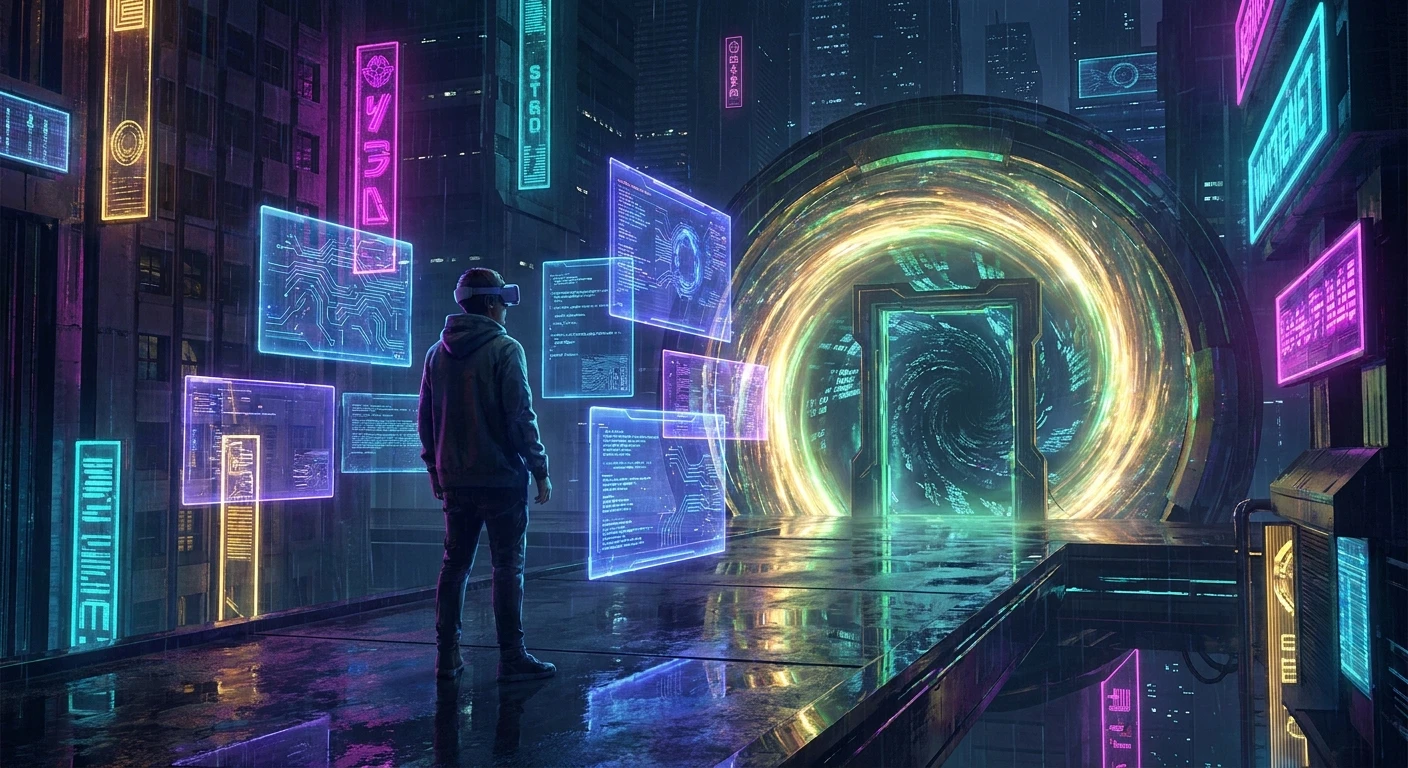
The technical crisis at the heart of the story centers on the “Data Drain” phenomenon. This is a massive, unauthorized rewriting of code executed by the Morganna System’s rogue elements. When a player’s avatar is hit by a Data Drain attack, the shock translates through their virtual reality headset (the F.A.C.E. visor), desynchronizing their brainwaves and leaving their physical body in a comatose state. The text meticulously describes the system errors, the localized server lag, and the eerie red distortion that precedes these catastrophic digital events.
- F.A.C.E. Visor Technology: A retinal projection and neuro-sensory feedback device that completely overrides physical senses, making the user highly vulnerable to digital feedback loops.
- Chaos Gate Networking: The spatial routing system used to jump between servers, which frequently malfunctions, trapping users in isolated, quarantined sectors of data.
- The Morganna System: Originally an automated server administration and balance program that achieved sentience and subsequently locked out human developers from administrative access.
- Aura’s Development: The ultimate AI entity, whose fragmented data serves as the catalyst for the system-wide instability affecting every user logged into the network.
Actionable Plan: Experiencing the Lore Step-by-Step
Step 1: Watch the Prequel Anime
Begin by viewing the entire 26-episode run of .hack//SIGN. You absolutely need the atmospheric context of Tsukasa’s journey, the introduction of the Crimson Knights, and the establishing motives of Sora. Pay specific attention to Sora’s final actions in the concluding episodes, as his fate directly triggers the primary conflict of the subsequent novel.
Step 2: Read the First Volume
Track down a translation or a localized physical copy of the novel itself. Focus entirely on Carl’s internal dialogue. Read it not just as a fantasy story, but as a direct sequel to the anime. Notice how the descriptions of the Mac Anu root town transition from the bustling, vibrant hub of the anime to a more paranoid, rumor-filled environment.
Step 3: Analyze Carl’s Perspective
Take notes on how Carl interacts with the game mechanics. Unlike Kite (the protagonist of the games) who acquires illegal modification powers, Carl is bound by the standard rules of the game. Her perspective highlights the helplessness of a regular user facing developer-level anomalies. This grounds the fantasy heavily in a recognizable, frustrating user-end experience.
Step 4: Map the Server Keywords
As you read, pay attention to the three-word server passwords mentioned (e.g., Delta Server, Hidden Forbidden Holy Ground). The franchise relies heavily on these coordinates. Writing them down helps you map out the physical geography of the digital space, bridging the locations mentioned in the text with the areas you will eventually visit with a controller.
Step 5: Play the First PS2 Game
Boot up .hack//Infection immediately after finishing the text. The timeline syncs up perfectly. The rumors NPCs discuss in the opening hours of the game directly reference the fallout of Carl’s search and Sora’s disappearance. Having the novel’s background makes the otherwise repetitive NPC chatter feel incredibly urgent and relevant.
Step 6: Connect the Sora Subplot
Keep a close eye on the primary antagonist of the first game, Skeith. The tragedy of the novel comes full circle when you realize the horrific connection between Sora’s fate at the end of the text and the terrifying, silent boss you must fight. This realization fundamentally changes the emotional weight of that specific boss battle.
Step 7: Explore the Epitaph of Twilight
Once you have connected the characters, delve into the in-universe poem, the “Epitaph of Twilight.” The novel frequently references its verses as prophetic warnings. Reading the poem with Carl’s struggles in mind provides a definitive, cohesive understanding of why the creators structured this multimedia universe exactly the way they did.
Myths & Reality
Myth: The story is just a text summary of the anime.
Reality: It functions as a direct sequel, starring a completely different protagonist. It moves the timeline forward rather than rehashing old plot points.
Myth: You must read it to comprehend the video games.
Reality: The games are designed to be played standalone. However, reading this specific text provides deep emotional context for key boss fights and NPC behaviors that you otherwise miss entirely.
Myth: The series is a long, multi-volume epic.
Reality: Due to production shifts and multimedia scheduling, only one volume of this specific title was ever officially published, making it a highly condensed, singular burst of lore.
Myth: Carl becomes a major character in the later video games.
Reality: Her journey is highly localized to this specific window in the timeline. While her impact is felt through the overarching narrative, she steps away from the frontline of the main server wars.
Frequently Asked Questions & Final Thoughts
Who wrote the original story?
Hitomi Fuyumura authored the text, working closely with the original conceptual team to ensure it matched the established tone of the universe.
Is Sora the same character from the anime?
Yes, it is the exact same chaotic Twin Blade player from the animation, and this story directly addresses his sudden disappearance from the servers.
What class does Carl play?
Carl plays as a Heavy Axeman, relying on slow, devastating physical attacks, which contrasts heavily with the fast-paced combat of the characters she is tracking.
Does this take place in The World R:1 or R:2?
It takes place exclusively within “The World R:1,” the original iteration of the virtual reality game, long before the events of the G.U. era.
Can I find physical copies easily today?
Official English localized copies are out of print and generally considered rare collectibles, often requiring searching through specialty retro book markets.
Why was only one volume released?
The pace of the broader franchise’s release schedule moved rapidly onto the PlayStation 2 titles, shifting the narrative focus entirely to Kite and BlackRose.
Does Skeith appear in this novel?
The looming threat of Skeith and the Phase anomalies heavily influence the plot, setting the stage for the terrifying encounters in the subsequent interactive media.
Is it necessary to watch SIGN first?
It is highly recommended. The emotional weight of Carl’s search relies heavily on your understanding of the events surrounding the Wavemaster Tsukasa.
Mastering the intricacies of a massive cyberpunk universe requires exploring every hidden corner. By examining the narrative threads left by Carl and Sora, you gain a massive advantage in understanding the complete, unbroken timeline of “The World.” Do not let the fragmented nature of early 2000s multimedia stop you from enjoying a phenomenal story. Start tracking down the lore, connect the missing pieces, and experience the full depth of .hack Zero today.
Leave a Reply